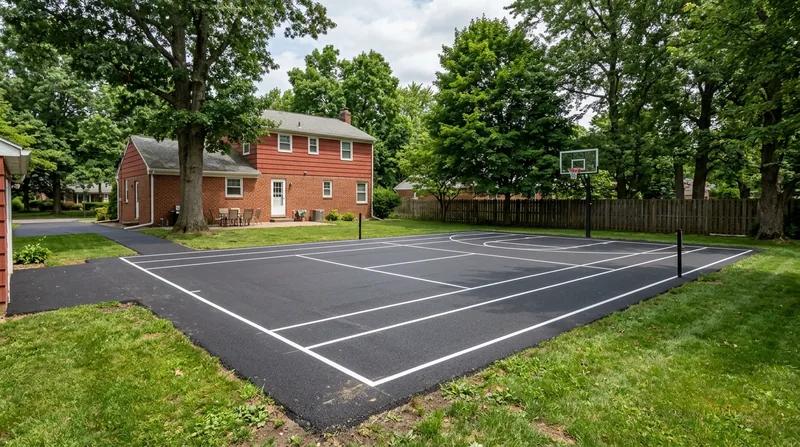




A backyard basketball court or tennis court in Buffalo faces a challenge that flat suburban driveways don't. The lake-plain clay underneath heaves and settles each winter as the freeze-thaw cycle repeats month after month, and a thin, hastily-laid surface will crack, buckle, and fail within a few seasons. Sports court and path paving in Buffalo demands a foundation that resists that movement, proper pitch to shed meltwater across terrain that wants to hold it, and hot mix asphalt or a specialized sport surface laid over a deep, compacted aggregate base. We build courts that stay true through the winters, and we've done it since 2010 across Buffalo, Cheektowaga, West Seneca, and the surrounding Erie and Niagara county communities where lake-effect snow and repeated plowing are the norm.
Why Sports Court and Path Paving Matters in Buffalo's Freeze-Thaw Climate
Buffalo's winters don't just bring snow, they bring repeated cycles of freezing and thawing that move the ground itself. Water trapped under a thin asphalt layer expands when it freezes, lifting and cracking the surface. Spring brings settling and more cracks. A court built on the wrong base, or pitched the wrong way, will fail in three to five years instead of ten to fifteen. The lake-plain clay that sits under most of Buffalo and the surrounding towns holds moisture against the base layer, which is why proper drainage and base depth are not optional extras, they are the foundation of the whole job.
- We install a compacted aggregate base deep enough to distribute load and resist heaving, typically four to six inches depending on soil conditions and court use.
- We pitch the court surface to shed water toward the edges or a drainage path, so meltwater runs off instead of pooling and refreezing.
- We use hot mix asphalt or sport-specific surfaces that flex slightly without cracking, holding their line through the freeze-thaw seasons.
- We verify local permitting requirements for impervious-surface limits and stormwater rules, which vary by municipality across Greater Buffalo.
The difference between a court that holds its playing surface and one that fails is built into the base and the drainage, and those decisions are made before the asphalt is ever laid.
Key info: Buffalo's lake-effect winters bring the heaviest snowfall in November and December, followed by months of freeze-thaw cycling and repeated plowing. A court built on a shallow or poorly-drained base will heave and crack within three to five seasons. The City of Buffalo and surrounding municipalities set stormwater and impervious-surface rules that affect how a court is graded and drained, and some jurisdictions require a permit before work begins. Verify requirements with your local building department before you call us.
For more on how we prepare the ground for any paved surface, see our gravel driveway installation and grading page, where the same base-preparation principles apply.
How We Build a Sports Court in Buffalo: The Process from Ground Up
A court is not just asphalt poured on dirt. We start with a site survey and a conversation about what the court will be used for, how much traffic it will see, and what the existing ground looks like. From there we grade, compact, and build the base in stages, each one checked and proven before the next layer goes down. The asphalt or sport surface is the final layer, but the court's life is determined by what we do underneath.
- We clear and excavate the site to remove topsoil and soft material, exposing stable subgrade.
- We bring in and compact a base course of crushed stone or recycled asphalt millings, building depth in lifts and proof-rolling each one to confirm density.
- We establish proper slope and drainage so water runs off the court surface instead of collecting at the edges or settling into the base.
- We lay hot mix asphalt in one or two lifts, compacted and finished smooth, or we install a specialized sport surface if the court is a competitive tennis or basketball facility.
- We mark lines and edges according to your specifications, and we do not seal the new asphalt for the first six to twelve months while it cures and hardens.
The entire process typically takes two to four weeks from site prep to a court ready to use, depending on weather and the size of the job.
Local example: A homeowner in Williamsville wanted a tennis court on a sloped lot with poor drainage. We excavated to stable ground, built a four-inch base of compacted recycled asphalt, and pitched the court to drain toward a swale on the downhill side. We then laid three inches of hot mix asphalt and marked the court lines. The court has stayed crack-free for five seasons and handles the lake-effect snow and freeze-thaw cycles without heaving.
Learn more about how we approach asphalt resurfacing and overlay work when an existing court or path needs repair or renewal.
Methods and Materials for Courts and Paths
| Approach | Description | Best for |
|---|---|---|
| Hot Mix Asphalt Court | Standard asphalt surface laid over a compacted aggregate base, pitched for drainage, finished smooth and marked with court lines. | Recreational basketball and tennis courts, multipurpose courts, pathways, and driveways to courts. |
| Recycled Asphalt Base | Crushed and compacted recycled asphalt millings used as the base course, reducing material cost and providing good drainage and compaction. | Budget-conscious courts and paths, rural properties, areas where recycled material reduces haul distance and cost. |
| Sport Surface Overlay | Specialized acrylic or polyurethane sport surface applied over a sound asphalt base, offering color, line marking, and improved ball response. | Competitive tennis courts, high-traffic basketball facilities, schools and community courts where durability and performance matter. |
| Path and Walkway Paving | Asphalt paths with proper base and slope, sized for foot and light vehicle traffic, built to the same drainage and compaction standards as courts. | Access paths to courts, walking trails, connecting driveways, and multi-use paths on residential and HOA properties. |
Sports Court and Path Paving Cost in Buffalo: What to Expect
A new recreational court in the Buffalo area starts at around $8,500 for a single-court installation on a relatively level site with good access and existing stable ground. That figure covers site prep, a compacted base, and hot mix asphalt laid and finished. The real cost depends on several concrete factors: the size of the court (a tennis court is roughly 2,600 square feet; a half basketball court is about 1,200 square feet), the existing site conditions (soft clay and poor drainage cost more to correct than stable ground), access for equipment, and whether you want a sport surface overlay or just asphalt with lines.
A full competitive court with a sport surface overlay will run higher. A simple path or secondary court on a well-drained site will cost less. The only way to know your actual cost is to have us visit the site, measure, and understand what's underneath. We provide written estimates with tonnage and thickness specs, so you know exactly what you are paying for and why.
We recommend getting two or three estimates from local contractors so you can compare what is included, what the base depth is, and whether the price reflects the actual site conditions. A quote that looks too good usually means the contractor is cutting corners on base depth or compaction, and you will pay for it in five years when the court starts to fail.
For a detailed breakdown of pricing on all our services, visit our pricing page.
Sports Court and Path Paving Near Me: What to Look for When Hiring a Contractor in Buffalo
A sports court is a long-term investment, and the contractor you choose will determine whether it lasts ten years or five. The same red flags that mark a paving scam anywhere apply here: unsolicited door-to-door offers, no written contract, a demand for a large cash deposit upfront, out-of-state plates, or a price that sounds too good to be true. The honest differentiator in this trade is a local contractor with a local address and local plates who will explain what they are doing, why, and what it costs.
- Verify that any contractor you hire carries full liability insurance and can provide a certificate of insurance before work begins.
- Check with your local building department or municipal clerk to find out whether a permit is required for your court, and confirm that the contractor will help you navigate the permitting process if one is needed.
- If your property is in a homeowners association or a historic district, verify HOA architectural standards or local design guidelines that may govern materials, colors, or surface finish.
- Ask for references from recent court or driveway projects in your area, and call at least two to ask about the quality of the base, how the surface has held up, and whether the contractor showed up when promised.
- Get a written estimate with tonnage, thickness, and materials specified, not just a lump-sum price or a price per square foot with no detail.
- Understand that New York State law requires a utility locate through 811 before any excavation, and any contractor who skips that step is breaking the law and putting your water, gas, and electric lines at risk.
Buffalo Asphalt Paving has been in business since 2010 and serves Buffalo, Cheektowaga, West Seneca, Tonawanda, Kenmore, and the surrounding towns. We are fully insured, we provide written estimates, and we help homeowners understand local permitting requirements. Call us at (716) 303-0919 for a free, no-obligation estimate, or visit our contact page to request an appointment.
Sports Court & Path Paving in Buffalo: Pricing Guide
| Service | Price | Details |
|---|---|---|
| Recreational Court (Tennis or Basketball) | Starting at $8,500 | Hot mix asphalt on a compacted base, court-size dependent, includes site prep and line marking |
| Court with Sport Surface Overlay | Starting at $12,500 | Asphalt base plus acrylic or polyurethane sport surface, color, and professional line marking for competitive play |
| Pathway or Secondary Court | Starting at $4,500 | Smaller asphalt surface with base, suited for access paths or half-courts on well-drained sites |
| Site Prep and Base Only | On estimate | Excavation, grading, compacted base course; cost depends on soil conditions, drainage needs, and site access |
| Travel and Estimate | Free | No charge for site visit or written estimate; response within 24 hours at (716) 303-0919 |
Indicative pricing, the exact cost depends on square footage, finish, and site access. Free personalized estimate within 24h at (716) 303-0919.


