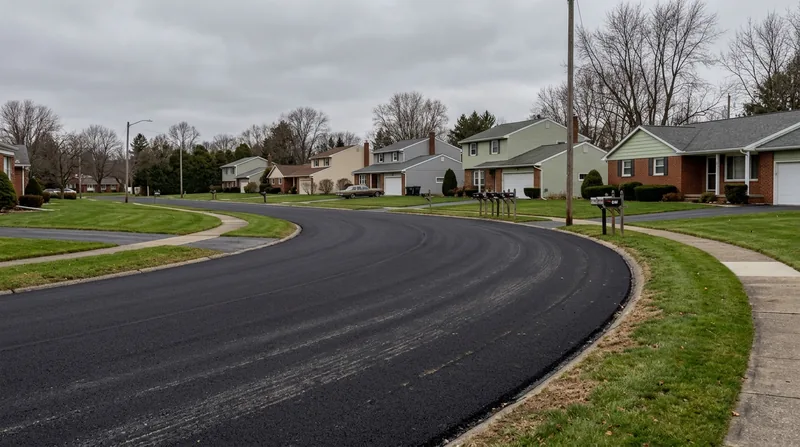




Private Road & HOA Paving in Buffalo means building a surface that holds up through lake-effect winters, heavy plowing, and the freeze-thaw cycles that dominate this region. Buffalo's subdivisions and master-planned communities sit on the same flat lake-plain clay that runs under the city's oldest neighborhoods. That clay holds water against the base and holds cold once it freezes, so a private road heaves and settles unevenly rather than simply wearing thin. Repeated plowing from November through March, combined with months of hard freeze-thaw crossings, tears at edges and aprons. We build a compacted aggregate base sized for that load, pitch the surface to shed meltwater across flat terrain, and pave to specifications your HOA board can sign off on. The result is a road that moves snow without cracking, drains properly, and stays stable through the season.
Why Private Road Paving Matters in Buffalo's Subdivisions
Private roads through Williamsville, Tonawanda Town, West Seneca, and other Buffalo suburbs carry the same traffic and weather stress as public roads, but without municipal maintenance budgets. An HOA board is responsible for keeping a road passable and safe, which means controlling drainage, managing plowing damage, and planning for surface failure before it becomes an emergency. Asphalt built on a proper base and pitched correctly can hold for fifteen to twenty years in this climate. A road built without proper base preparation or pitch fails much faster, leaving the HOA to choose between expensive patching and early replacement.
- We size the aggregate base to handle the weight of snow-removal equipment and freeze-thaw stress typical of Buffalo winters.
- We pitch the road surface to drain water away from the base, preventing the pooling that accelerates failure on flat terrain.
- We specify asphalt thickness and binder grade appropriate for the lake-effect climate and heavy plowing your road will see.
- We provide written estimates that include tonnage, thickness, and base specifications so your HOA board has the information it needs to approve the work.
Getting this right the first time saves your HOA thousands in emergency repairs and early resurfacing.
Key info: Buffalo and surrounding towns require HOAs to verify that any paving contractor is properly insured and that the work meets local grading, drainage, and stormwater standards. Check with your municipality and your HOA architectural review board before soliciting bids. We work with your local building department and HOA requirements to make sure the job clears permitting.
For more context on how asphalt holds up in this climate, see our page on asphalt resurfacing and overlay, which covers the lifecycle of a paved surface in Buffalo.
How We Build a Private Road in Buffalo: From Base to Finish
Private road paving starts with understanding the terrain and traffic pattern of your specific road. We measure the length and width, inspect the existing surface and base condition, and assess drainage and grading. From there we develop a specification that your HOA board can review and approve before we mobilize equipment. The work follows a sequence designed to handle Buffalo's heavy freeze-thaw and plowing stress.
- We inspect the existing road surface and base, identifying soft spots, poor drainage, and areas where the base has failed.
- We mill or remove the existing asphalt, if necessary, and dispose of it responsibly or recycle it into the new base.
- We grade and compact the subgrade, then lay a compacted aggregate base of the thickness specified for your road's traffic load and climate.
- We proof-roll the base with heavy equipment to verify compaction and identify any soft spots that need rework.
- We lay hot-mix asphalt in lifts, compacting each layer to the density required for durability in freeze-thaw conditions.
- We finish with a top course of asphalt pitched to shed water and textured for traction in winter conditions.
The entire process takes two to four weeks depending on road length, weather, and whether the base needs replacement or can be recycled.
Local example: A half-mile private road in a Cheektowaga subdivision with 40 homes required milling the existing surface, replacing the base in two sections where clay had softened, and paving with a thicker top course to handle the plowing and traffic. The HOA approved the work in writing, the local building department inspected the base prep, and the road was open to traffic three weeks later.
See our page on asphalt milling and removal for details on how we handle existing pavement.
Private Road Paving Methods and Materials
| Approach | Description | Best for |
|---|---|---|
| Full-Depth Replacement | We mill the existing asphalt, remove and replace the base if needed, and pave with new hot-mix asphalt in multiple lifts. | Roads with failed or soft bases, poor drainage, or structural damage that will not hold an overlay. |
| Mill and Overlay | We mill the top course of the existing road, inspect the base, and lay a new asphalt surface over the recycled base. | Roads with sound bases and surface wear but no structural failure, extending life by eight to twelve years. |
| Recycled Asphalt Base | We recycle the milled asphalt into the new base course, reducing waste and material cost while maintaining structural quality. | Cost-conscious HOAs where the existing base is sound and milled material can be reused responsibly. |
| Base Grading and Drainage | We regrade the road subgrade, improve drainage by resloping or adding drainage structures, and prepare a compacted base for paving. | Roads with poor drainage, pooling, or soft clay subgrades that need structural correction before any asphalt is laid. |
Each approach is chosen based on the condition of the existing road, the HOA's budget, and the long-term performance expected in Buffalo's freeze-thaw climate.
Private Road and HOA Paving Cost in Buffalo: What to Expect
Private road paving in Buffalo starts at around $15,000 to $20,000 for a short residential road, but the final cost depends on length, width, base condition, and whether drainage or grading work is needed. A half-mile road with 40 homes and a sound base might run $35,000 to $50,000. A road that requires base replacement or extensive grading can cost significantly more. The best way to understand the cost for your specific road is to have us measure it, inspect the existing surface and drainage, and provide a written estimate with tonnage and thickness specifications.
Several factors move the price up or down:
- Road length and width determine the total square footage and the tonnage of asphalt and base material needed.
- Existing surface condition affects whether the road can be overlaid or requires full-depth replacement and base work.
- Drainage and grading needs, especially on flat lake-plain terrain, may require resloping or drainage structures that add cost.
- Access and equipment staging space influence how quickly we can mobilize and how efficiently we can work.
- Timing and weather can affect scheduling and material costs, particularly in the off-season.
We recommend getting two to three written estimates from contractors who will specify tonnage, thickness, and base composition. This lets your HOA board compare apples to apples and make an informed decision. See our pricing page for more detail on what affects cost and how we structure estimates.
What to Look for When Hiring a Private Road Paving Contractor Near Buffalo
Hiring the right contractor for your private road is critical because the work is expensive and will affect your HOA's budget for years. A poorly built road will fail early and leave you with unexpected repair bills. A well-built road will hold for fifteen to twenty years with routine maintenance. Here is what to verify before you hire.
- Confirm that the contractor is fully insured and ask to see a certificate of insurance naming your HOA as an additional insured.
- Ask for written estimates that include the tonnage of asphalt and base material, the thickness of each layer, and the base specifications.
- Check references from other HOAs or municipalities the contractor has paved for, and ask about the longevity of the work.
- Verify that the contractor understands local permitting requirements, including any municipal grading or drainage approvals needed before work begins.
- Confirm that the contractor will work with your HOA architectural review board to ensure the finished road meets community standards.
- Get a detailed timeline for the work, including how long the road will be partially closed and when it will be fully open to traffic.
Avoid contractors who offer unsolicited bids, ask for large cash deposits before work begins, provide estimates without measuring the road or inspecting the base, or claim they have leftover material from another job. These are warning signs of inexperience or worse. Contact us for a free estimate with no obligation. We measure your road on site, inspect the existing surface and base, and provide a written specification your HOA board can review and approve before we start work.
Private Road & HOA Paving in Buffalo: Pricing Guide
| Service | Price | Details |
|---|---|---|
| Short private road (1/4 mile or less, sound base) | Starting at $15,000 | Full-depth replacement or mill and overlay, includes base inspection and new asphalt paving with proper pitch |
| Medium private road (1/4 to 1/2 mile, base work included) | Starting at $30,000 | Milling, base grading or replacement, and new asphalt, cost varies with base condition and drainage needs |
| Longer subdivision road or complex drainage | On estimate | Length, width, base condition, and drainage requirements must be inspected on site before a firm price is given |
| Recycled asphalt base option | Reduces total cost | Milled material is recycled into the new base, lowering material expenses while maintaining structural performance |
| Travel and mobilization | Included | No separate mileage fee or call-out charge for work in Buffalo and surrounding Erie and Niagara County towns |
| Free estimate | No obligation | On-site inspection and written estimate with tonnage and specifications, response within 24 hours at (716) 303-0919 |
Indicative pricing, the exact cost depends on square footage, finish, and site access. Free personalized estimate within 24h at (716) 303-0919.


