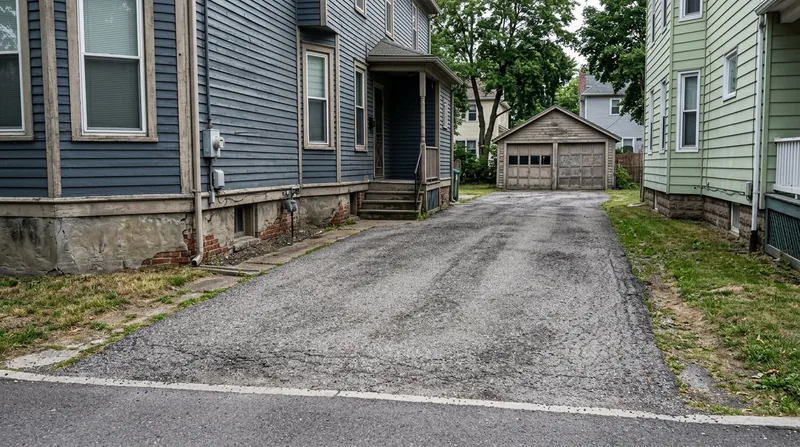




Recycled asphalt and millings driveways offer Buffalo homeowners a practical, stable surface option for long side drives and rural lanes without the full cost of hot mix paving. Buffalo's dense Victorian neighborhoods and post-war suburbs rely on narrow, tight driveways that sit on the heavy lake-plain clay common across Erie County, a soil that holds water against the base and heaves unevenly through the freeze-thaw cycles of lake-effect winters. Recycled millings, compacted and graded to shed meltwater, give these drives a solid wearing surface that resists the settling and cracking that softer materials surrender to. We grade and compact the material so it bonds firmly, sheds meltwater across the flat terrain, and holds up through repeated plowing and the hard freeze-thaw crossings of November through March. For homeowners looking for a budget-conscious alternative to new hot mix asphalt, or for rural properties where a gravel base needs upgrading, recycled millings deliver durability and drainage without the premium price.
Why Recycled Asphalt Millings Make Sense for Buffalo Driveways
Buffalo's residential fabric runs the full spectrum, from the narrow side drives of the city's oldest blocks to the wider suburban aprons of Cheektowaga, West Seneca, and Williamsville. The lake-plain clay beneath all of it is the real constraint. It drains slowly, holds water against the base, and when winter comes and the freeze-thaw cycle begins, it heaves unevenly, breaking up softer surfaces and stressing the edges of any driveway that sits on an inadequate base. Recycled millings, when properly graded and compacted, lock together and shed water rather than trapping it, which is why they outperform loose gravel in Buffalo's climate.
- Recycled millings bond under compaction and resist the settling that loose gravel surrenders to.
- The material sheds meltwater across the flat lake-plain terrain and reduces heaving at the base.
- Cost runs well below hot mix asphalt, making it the right choice for long rural drives and budget-conscious homeowners.
- Millings are reusable material from reclaimed asphalt pavement, so material cost is lower than virgin hot mix.
- The surface hardens over time as traffic compacts it and binder material re-activates, creating a semi-stable wearing layer.
These advantages make recycled millings the practical choice for properties where a gravel base is failing or where hot mix cost does not fit the budget.
Key info: Buffalo's freeze-thaw cycle, which runs hardest from November through March, is the dominant failure mode for driveways on clay. Recycled millings shed water and resist heaving better than loose gravel, but they still require proper grading and a solid base to perform through the winter. A side drive in Buffalo's East Side that receives plowing three to four times per winter needs a compacted, well-pitched surface to hold up.
For more information on how recycled millings compare to other driveway surfaces, see our guide to gravel driveway installation and grading.
How We Install Recycled Asphalt Millings Driveways in Buffalo
The work begins with grading and site prep. We remove any failed surface, establish proper drainage slope so meltwater runs away from the foundation and sheds across the drive toward the street or yard, and then lay down a compacted base of recycled millings in lifts, compacting each layer so it bonds and resists displacement. The final lift is raked and crowned slightly to pitch water, then lightly compacted so it sets firmly without over-working the material. Proper pitch is critical in Buffalo, where standing water freezes and heave begins.
- We measure the drive and calculate tonnage so the estimate is specific to your job, not a guess.
- We grade the base to remove soft spots and standing water, establishing a pitch that sheds meltwater away from your home.
- We deliver and spread recycled millings in compacted lifts so the material bonds and resists settling.
- We crown the final surface lightly so water runs off and does not pool in freeze-thaw cycles.
- We compact the finished drive with a vibratory roller so the material sets and hardens under traffic over the first few weeks.
The result is a stable, durable surface that hardens further as traffic and weather compact it over the first season.
Local example: A 400-square-foot side drive in Kenmore with a failed gravel base and poor drainage took two days to grade, prep, and lay recycled millings in three compacted lifts. The pitch was set to shed water toward the street, and the homeowner saw the difference in meltwater runoff immediately. By the second season, traffic had compacted the surface into a semi-stable wearing layer that resisted the freeze-thaw heaving that had broken up the original gravel.
If your drive is older asphalt that is broken but still has a solid base, see our asphalt resurfacing and overlay page for a longer-term option.
Recycled Millings Approaches: Grading, Base Prep, and Compaction Methods
| Approach | Description | Best for |
|---|---|---|
| Grading and compacted millings on existing base | We grade the existing surface, establish pitch, and lay recycled millings in two to three compacted lifts on top of a stable base. | Drives with a sound aggregate or old asphalt base that needs a new wearing surface without full removal. |
| Full base prep with recycled millings | We remove failed surface, excavate soft clay, install a compacted aggregate base, and lay millings in three to four lifts with proper pitch and compaction. | Rural drives with poor drainage, failed gravel, or clay heave that needs a solid foundation. |
| Recycled millings overlay on existing asphalt | We mill or scarify the old asphalt surface lightly to improve bonding, then lay recycled millings in compacted lifts for a lower-cost refresh. | Older asphalt drives in fair condition where the base is solid and a low-cost wearing surface is the goal. |
| Recycled millings with edge stabilization | We install millings with gravel or recycled asphalt along the edges and shoulders so the drive holds its shape through plowing and settling. | Long side drives and rural lanes that receive regular plowing and need edge support to resist spreading. |
Recycled Asphalt and Millings Driveways Cost in Buffalo: What to Expect
Recycled millings driveways in Buffalo typically run from $3 to $5 per square foot installed, depending on the condition of the existing base, the depth of grading required, and the compaction method. A 400-square-foot side drive with a sound base and minimal grading might cost $1,200 to $2,000 for material and labor. A rural property with poor drainage, failed gravel, and clay heave that needs full base prep and three to four compacted lifts of millings can run $2,000 to $3,500 or more. The cost difference comes down to base condition, site access, and how much excavation and grading are needed to establish proper pitch and drainage.
Several factors move the price up or down. A drive with a failed or missing base costs more because we must excavate, remove soft clay, and install a solid aggregate foundation before laying millings. Long, narrow side drives in Buffalo's older neighborhoods are cheaper per square foot because the work is contained and straightforward. Rural properties with poor access or soft ground may require additional equipment or more compaction passes. The best way to know the actual cost is to call us at (716) 303-0919 for a free estimate. We measure the drive, assess the base, and give you a tonnage specification and a firm price before any work begins.
For a detailed pricing overview covering all our services, see our full pricing page.
Recycled Asphalt and Millings Driveways Near Me: What Buffalo Homeowners Should Know When Hiring a Contractor
Choosing the right paving contractor for a recycled millings project means verifying a few key things up front. First, confirm that any contractor you hire carries full insurance coverage. Second, get written estimates from at least two contractors so you can compare the tonnage, depth, and compaction method each one proposes. A vague estimate that gives you a price per square foot without specifying tonnage or base preparation is a red flag. Third, ask for references from recent jobs in Buffalo or nearby suburbs, and follow up with at least one to confirm the work quality and timeline. Finally, understand your local permitting rules. Some Buffalo neighborhoods and HOAs have rules about driveway surfaces or extensions. Call your local building department or HOA before you begin to confirm what is allowed and whether a permit is required.
- Verify that your contractor carries full liability and property damage insurance and can provide a current certificate on request.
- Get written estimates that specify tonnage, base depth, compaction method, and final pitch so you understand what you are paying for.
- Ask for references from Buffalo-area jobs completed in the last two years and call them to confirm quality and timeline.
- Check with your city building department or HOA before work begins to confirm permitting rules and driveway surface requirements.
- Avoid contractors who offer unsolicited door-to-door estimates, demand a large cash deposit, or quote a price that seems too good to be true.
A local contractor with Buffalo plates, a local address, and verifiable references is the safest choice. We have been in business since 2010 and serve the greater Buffalo area. Call us at (716) 303-0919 for a free estimate, or visit our contact page to request one online.
Recycled Asphalt & Millings Driveways in Buffalo: Pricing Guide
| Service | Price | Details |
|---|---|---|
| Recycled millings on stable base | Starting at $3/sq ft | Grading, two to three compacted lifts of recycled millings, proper pitch and drainage on sound existing base |
| Full base prep with recycled millings | Starting at $4.50/sq ft | Excavation, soft clay removal, compacted aggregate base, three to four lifts of millings, edge stabilization, and pitch |
| Recycled millings overlay on asphalt | Starting at $2.50/sq ft | Light scarification of existing asphalt, two to three compacted lifts of recycled millings, minimal base work required |
| Large rural property or complex site | On estimate | Full site survey, drainage analysis, base design, and equipment deployment require on-site assessment before pricing |
| Free estimate and site visit | No charge | Written tonnage spec and firm price within 24 hours, no obligation to book, call (716) 303-0919 |
Indicative pricing, the exact cost depends on square footage, finish, and site access. Free personalized estimate within 24h at (716) 303-0919.


