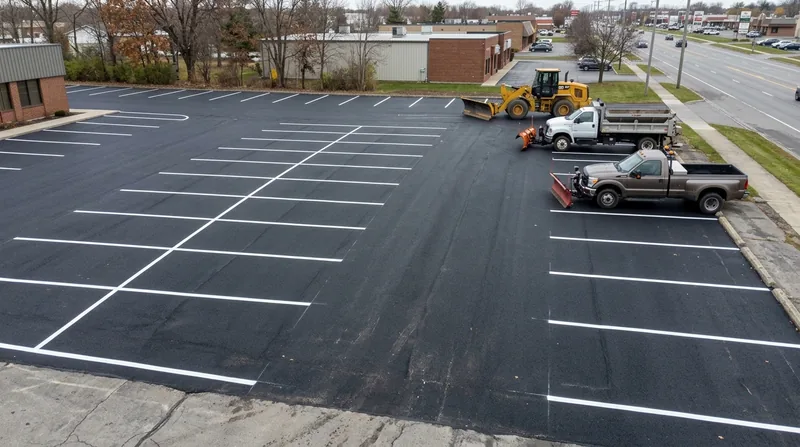




Buffalo's commercial parking lots face a relentless cycle of freeze-thaw cracking, salt damage, and heavy plow wear that demands a foundation built for the lake-effect climate. Parking Lot Paving & Construction in Buffalo requires base engineering sized for the flat lake-plain terrain, proper pitch for drainage across terrain that holds water, and hot mix asphalt laid thick enough to absorb repeated plowing without edge failure. We build parking lots that shed meltwater, resist salt intrusion, and hold up to the winter load Buffalo throws at them every November through March.
Why Parking Lot Paving Matters in Buffalo's Commercial Climate
A parking lot is not a driveway scaled up. It carries truck traffic, delivery vehicles, and constant plowing pressure. Buffalo's lake-effect snowfall, heaviest in November and December, means your lot will see the plow blade multiple times per season, and salt brine will sit on the surface for weeks. The lake-plain clay underneath drains slowly, which means water pools against the base during spring melt and freeze-thaw cycles crack the surface from below. A lot built on a compacted base with proper crown, pitched to drain across the flat terrain, and laid with the right asphalt thickness will last 15 to 20 years with routine maintenance. A lot built thin or on poor drainage will fail in half that time, and patching becomes expensive fast.
- We size the base layer for the truck and plow load your lot will carry throughout the year.
- We pitch the lot surface to shed water across Buffalo's slow-draining lake-plain clay.
- We lay hot mix asphalt at the thickness needed to resist plowing damage and salt intrusion.
- We compact each layer to specification so the lot does not settle unevenly under load.
A properly built lot protects your investment and keeps your property accessible all winter long.
Key info: Buffalo and surrounding areas like Cheektowaga and Tonawanda see 90 to 120 inches of snow annually, with the heaviest lake-effect squalls in November and December. That volume of snow, plus repeated plow passes and salt application, is the dominant failure mode for parking lots built on inadequate base or poor drainage. A lot engineered for that load will hold.
The City of Buffalo requires permits for new construction and significant alterations to impervious surfaces. Check with your local building department before you start, and verify any HOA architectural standards if your property is in a master-planned community. New York 811 utility locates are required by law before any excavation, which full-depth construction and base work involve. We help you navigate the permitting process and coordinate with your municipality. For details on local permit requirements, visit the City of Buffalo Department of Permit and Inspection Services.
How We Build a Parking Lot That Holds Up in Buffalo
Parking lot construction is a sequence: we start with site assessment and drainage planning, excavate and prepare the subgrade, build a compacted aggregate base, and finish with hot mix asphalt. Each step is sized for Buffalo's terrain and climate. We do not cut corners on base depth or compaction, because that is where lots fail in the long term.
- We assess drainage patterns and slope the lot to shed water away from the structure and toward storm drains.
- We excavate and proof-roll the subgrade to ensure a stable bearing surface for the base layer.
- We install a compacted stone base, typically 4 to 6 inches, sized for the load and drainage your lot will carry.
- We lay hot mix asphalt in two or three lifts, compacting each to specification as it cools.
- We stripe and mark parking spaces, drive aisles, and directional arrows per your site plan.
The result is a lot that drains properly, resists plowing damage, and is ready for years of service.
Example: A medical office in Williamsville needed a 12,000-square-foot lot rebuilt after the original base failed and water pooled in the center after every thaw. We excavated to grade, installed a 5-inch compacted base with positive drainage toward the perimeter storm drain, and laid 3 inches of hot mix asphalt in two lifts. The lot now sheds water cleanly and has held up through three winters of heavy plowing. That is the difference a properly engineered base makes.
For related work on existing lots, see our Parking Lot Repair & Resurfacing service.
Parking Lot Paving Methods and Approaches
| Approach | Description | Best for |
|---|---|---|
| Full-Depth Construction | Excavate to subgrade, install new base and asphalt from the ground up. | New lots, failed existing lots, sites requiring improved drainage or load capacity. |
| Mill and Overlay | Remove the top 1.5 to 2 inches of existing asphalt and lay new hot mix over the remaining base. | Lots with sound bases but worn or cracked surfaces; extends life 10 to 15 years. |
| Recycled Asphalt Millings | Spread reclaimed asphalt millings as a temporary surface or base layer, compacted and binding over time. | Budget-conscious temporary lots, rural parking areas, or base reinforcement before full paving. |
| Grading and Site Prep | Excavation, subgrade preparation, compaction, and drainage layout before paving begins. | All new construction; ensures proper slope, drainage, and a stable bearing surface. |
Each approach is chosen based on the existing condition of the lot, your budget, and the load and drainage demands of your site. We assess the lot on-site and recommend the method that gives you the best long-term value.
Parking Lot Paving & Construction Cost in Buffalo: What to Expect
Parking lot paving is quoted on-site because cost depends on lot size, existing conditions, base requirements, and drainage work. A free commercial estimate is the right starting point. We measure the lot, assess the subgrade and drainage, and give you a written estimate with tonnage and thickness specs so you know exactly what you are paying for.
Several factors move the cost up or down. A new lot on virgin ground costs more than an overlay of an existing lot because base preparation takes time and materials. If the existing lot has poor drainage or a failed base, we may need to excavate deeper and install additional stone base, which adds cost. Lot size is the primary driver: a 5,000-square-foot lot costs less per square foot than a 50,000-square-foot lot because setup and equipment costs are spread across more area. Access matters too. If the site is tight, with limited turning radius for trucks or close proximity to buildings or utilities, the work moves slower and costs more. Timing affects cost as well. Spring and fall are our busy seasons, and summer is slower. A job scheduled in June or September may cost less than the same job in April or October.
Get two or three estimates from local contractors. A written estimate should include lot dimensions, base depth and material, asphalt thickness, tonnage, and a timeline. If an estimate is missing tonnage or thickness specs, ask for them. That is how you compare apples to apples. Our estimates are free, and we respond within 24 hours. Call us at (716) 303-0919 or visit our pricing page for guidance on typical costs in the Buffalo area.
What to Look for When Hiring a Paving Contractor Near Me in Buffalo
Choosing a contractor for a parking lot is a bigger decision than a driveway because the lot is a capital asset and the work is more complex. Start by verifying that any contractor you consider is fully insured and carries workers compensation. Ask for proof of insurance and verify the policy is current. Get three estimates, and ask each contractor to explain their base depth, asphalt thickness, and tonnage. If a contractor cannot or will not put those specs in writing, move on. Check references, especially recent commercial work in Buffalo or the surrounding area. A contractor who has done lots in Cheektowaga, Tonawanda, or Lackawanna will understand the local terrain and winter conditions.
Verify that the contractor understands local permitting. The City of Buffalo requires permits for new construction and significant alterations to impervious surfaces. If your lot is in an HOA or master-planned community, verify that the paving material and design meet architectural standards before you sign a contract. Ask the contractor whether they coordinate utility locates through New York 811, which is required by law before any excavation. A contractor who has worked in Buffalo knows these steps and will not cut corners.
Be wary of unsolicited door-to-door offers, large cash deposits before the work starts, or a price that seems too good to be true. Honest contractors give you a written estimate with specs, a timeline, and a clear payment schedule. If you have questions about our work or want a free estimate, contact us or call (716) 303-0919. We are local, we know Buffalo, and we are happy to answer your questions.
Parking Lot Paving & Construction in Buffalo: Pricing Guide
| Service | Price | Details |
|---|---|---|
| Free Commercial Estimate | Free | On-site assessment, lot measurement, drainage evaluation, and written estimate with tonnage and thickness specifications |
| Full-Depth Construction | Starting at $3.50 per sq ft | Includes excavation, compacted stone base, and hot mix asphalt; cost rises with depth of excavation and base requirements |
| Mill and Overlay | Starting at $1.75 per sq ft | Removes top layer of existing asphalt and installs new hot mix; requires sound base layer to be cost-effective |
| Recycled Asphalt Millings Base or Surface | Starting at $0.75 per sq ft | Compacted reclaimed asphalt material; suitable for temporary or secondary lots, or reinforcement before full paving |
| Grading and Site Preparation | On estimate | Excavation, compaction, and drainage work prior to paving; cost depends on site size, slope, and subgrade condition |
| Travel and Response | Included | No separate mileage fee or travel charge in Buffalo and surrounding areas; free estimate response within 24 hours |
Indicative pricing, the exact cost depends on square footage, finish, and site access. Free personalized estimate within 24h at (716) 303-0919.


